Retaining Wall Drainage in Bethlehem, PA: Cost & Process
The drain behind the wall is the part nobody sees and the part that decides whether the wall lasts. Most failed walls turn out never to have had a working one.
Get a Free Quote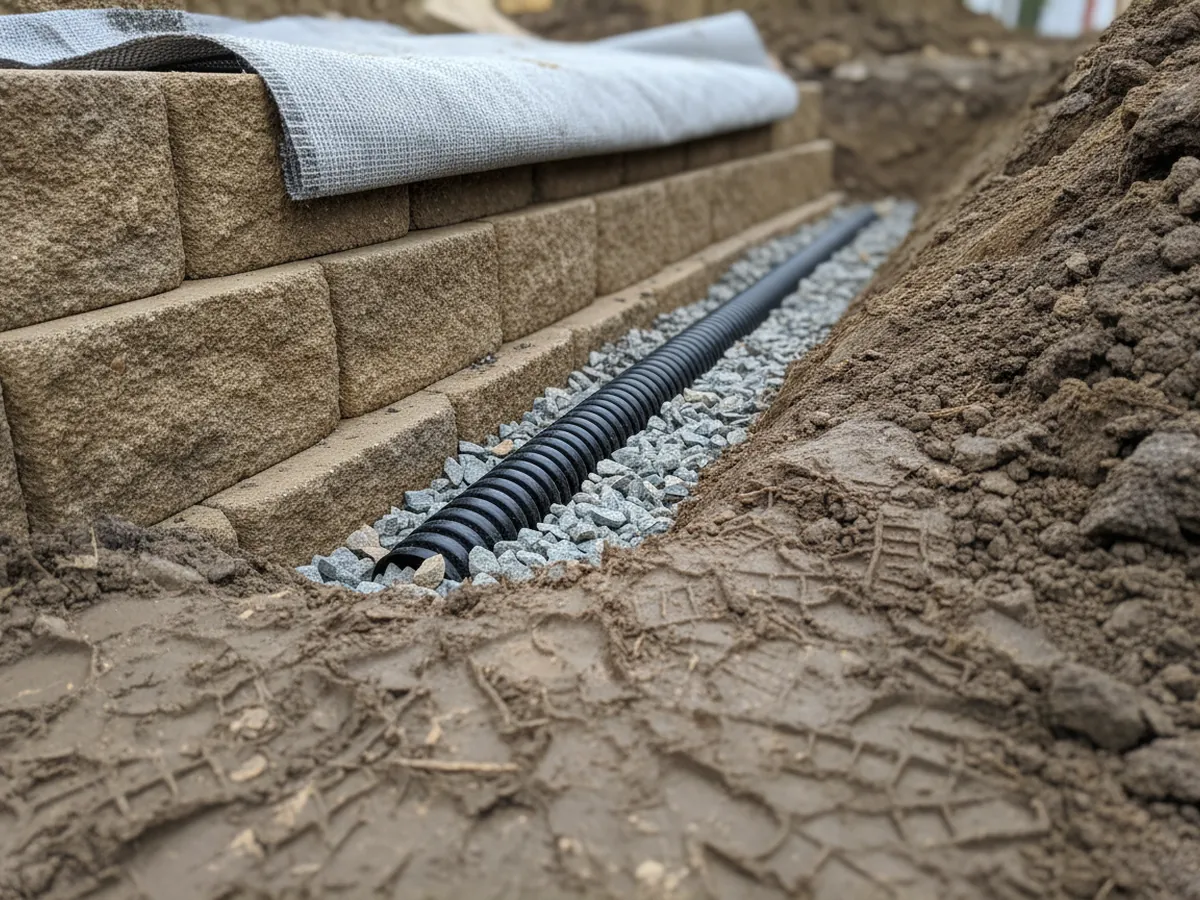
The drain behind the wall is the part nobody sees and the part that decides whether the wall lasts. Most failed walls turn out never to have had a working one.
Get a Free QuoteEvery retaining wall is really a drainage structure with a decorative face. Behind a correctly built wall sits a column of clean gravel, a perforated pipe at its base, and a filter fabric keeping soil out of the gravel. Water entering the slope reaches the gravel, drops to the pipe, and leaves. Take any one of those away and water stays in the soil, and the wall carries a load it was never sized for.
The most common failure is not a missing pipe but a pipe that goes nowhere. A drain line that ends buried in the backfill, crushed under a later patio, or discharging into soil that is already saturated is doing nothing. The outlet has to daylight somewhere lower than the pipe and stay clear. Locating an existing outlet, or proving there is not one, is usually the first hour of any wall investigation. On Bethlehem's limestone side of town the outlet's location matters twice over: the Lehigh Valley's carbonate belt is mapped karst, and concentrating roof and wall water into one spot of sinkhole-prone ground is how a drainage problem becomes a ground problem.
Filter fabric fails quietly. Without it, fine soil migrates into the gravel over several seasons until the drainage column is effectively soil again, and the wall starts taking saturated loads without any visible change. Walls that pass a decade and then move suddenly have often been slowly clogging that whole time.
The drain line is traced to its discharge point. Buried, crushed and never-installed are all common findings and each changes the scope.
Water is run into the system to see whether it actually exits. A pipe that exists but does not flow is the same as no pipe.
The backfill is opened behind the wall to the depth the repair needs — the minimum required to reach the failure.
Perforated pipe on a bed of clean angular gravel, wrapped in filter fabric, backfilled with gravel rather than the soil that came out.
The line is run to a discharge point below the pipe and away from the wall, and you watch water go in one end and come out the other.
Rarely. Weep holes let water out of the wall face but do nothing to move it through the soil behind. Without gravel and a drain line, the soil stays saturated and the wall keeps carrying the load.
Often yes, if the wall itself is sound — the work happens behind it rather than through it. A wall that has already moved usually needs both jobs at once.
To a point lower than the drain pipe, clear of the wall and clear of a neighbouring property. On flat sites that means a longer run or a dry well, and you should see where it terminates.
We focus on Bethlehem and the immediate area — which means realistic scheduling, local pricing, and follow-through. Every job starts with a clear scope and a written price.
A leaning or bulging wall is holding back tons of saturated soil and losing.
Leaning is the wall telling you the load has beaten it.
When a wall is past repair, rebuilding it right is cheaper than repairing it twice.
All retaining wall repair services in Bethlehem, PA · About this service