Wall Rebuilds & Replacement in Bethlehem, PA: Cost & Process
When a wall is past repair, rebuilding it right is cheaper than repairing it twice. That includes the base and the drainage nobody sees.
Get a Free Quote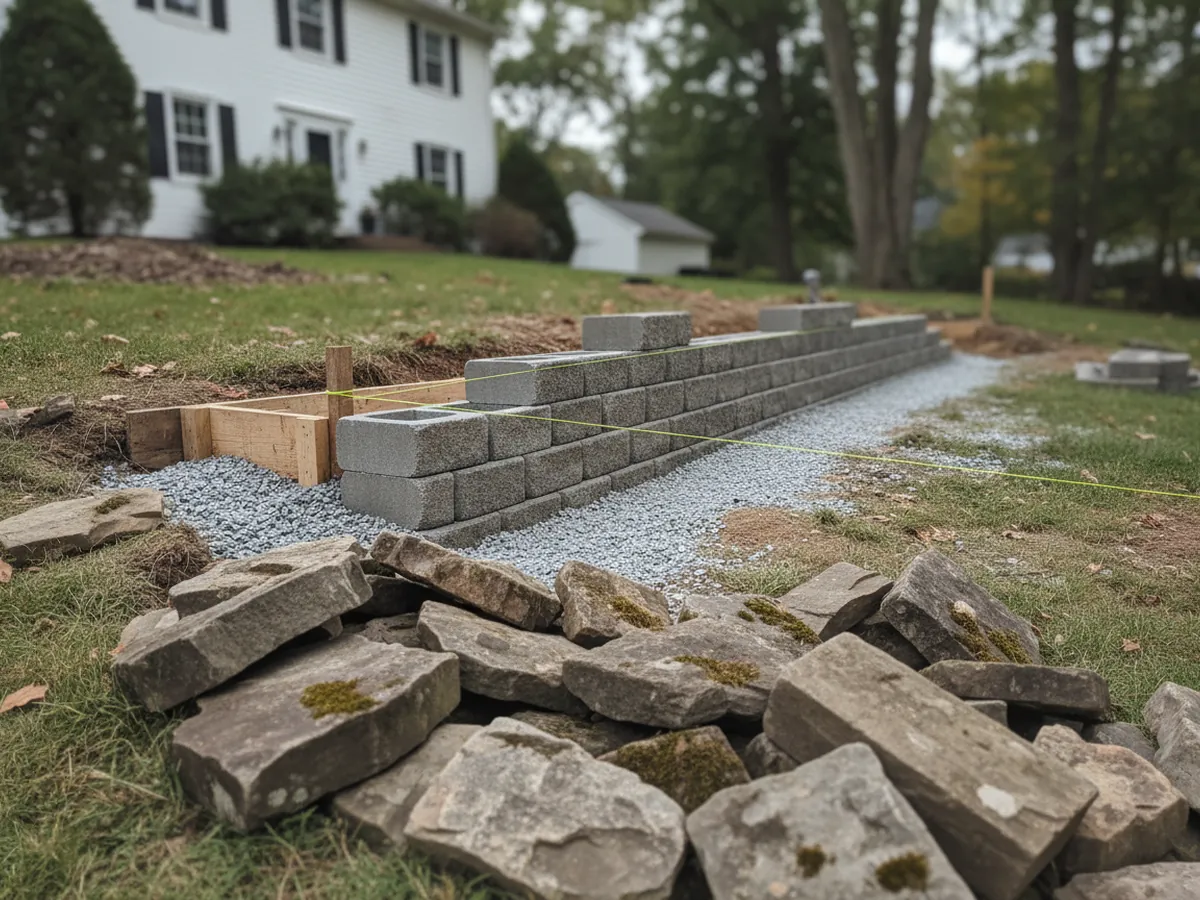
When a wall is past repair, rebuilding it right is cheaper than repairing it twice. That includes the base and the drainage nobody sees.
Get a Free QuoteRebuilding is the right call when the base has failed, when timbers have rotted through, or when the wall was built to a height its construction never supported. At that point resetting the face is repairing the visible half of a failure whose other half is underground, and it buys a couple of seasons at best.
The base is where a rebuild is won or lost. A compacted gravel base, level and deep enough to sit below Bethlehem's 30-inch frost line — the depth the city's building code writes into IRC Table R301.2(1), is what keeps the first course from moving — and everything above the first course inherits whatever that course does. A rebuild that reuses the old base to save a day is a rebuild that has already decided how it ends.
Timber walls are the usual replacement candidates. Landscape timbers have a service life measured in a couple of decades in wet ground, and the deadmen tying them back into the slope rot before the visible face does, so the wall can look sound right up until it does not. Converting to segmental block on a proper base is typically the point at which a wall stops being a recurring expense. Bethlehem's housing stock makes this a live question: the median home here was built in 1958 and about six in ten predate 1970, so a large share of the city's timber and first-generation block walls are already past the age where rebuilding beats patching.
The base is the thread running through most of these. Bethlehem's 30-inch frost line is not a retaining wall rule — IRC Table R301.2(1) sets the same bearing depth for deck footings, porch piers and anything else carried on soil, and the figure climbs steeply further north, which is why a deck builder working in Concord, New Hampshire digs considerably deeper for the same structure. A first course that never reached frost depth is the most common reason a rebuilt wall moves a second time.
What can be reused gets identified before demolition — sound block, cap stones and clean gravel all reduce the material bill.
Height is measured and the local permitting threshold named. Above it, an engineered design comes before the rebuild rather than after.
Down to undisturbed soil, then a compacted gravel base to depth, levelled properly — this is the part that determines whether the wall is still straight in twenty years.
Courses laid to line and batter, geogrid at the specified depths, drainage column built as the wall goes up rather than backfilled against afterward.
Backfill compacted in layers rather than dumped, then you get a record of what is behind the wall: grid depths, drain route and outlet location.
If the base has rotated, the timbers are rotten, or the wall has already been repaired once and moved again, rebuilding is usually cheaper over any real time horizon. A sound wall with bad drainage is a repair.
Often much of it. Undamaged units are salvaged and reused; cracked and spalled ones are replaced. The salvage estimate is part of the quote.
A segmental block wall on a compacted base with working drainage and correct reinforcement is a multi-decade structure. Nearly every early failure traces back to base or drainage, not to the block.
We focus on Bethlehem and the immediate area — which means realistic scheduling, local pricing, and follow-through. Every job starts with a clear scope and a written price.
A leaning or bulging wall is holding back tons of saturated soil and losing.
Leaning is the wall telling you the load has beaten it.
The drain behind the wall is the part nobody sees and the part that decides whether the wall lasts.
All retaining wall repair services in Bethlehem, PA · About this service